

How to choose an online maths tutor in Pakistan, from primary to entry tests
By the Hunarzai team. Facts checked 13 October 2026.
The short answer
A good online math tutor explains each method step by step, sets regular practice and checks your working, not just your final answers. On Hunarzai, maths courses can be recorded (up to PKR 4,999), live with a teacher at set times (up to PKR 9,999) or hybrid (up to PKR 7,999), and each course states its level and prerequisites. To start, decide your stage and board, pick the course type that suits how you learn, and check the refund rules before you pay.What makes a good online maths tutor
Maths is a subject you learn by doing. Watching someone solve a question feels easy. Solving the next one alone is where learning happens. So the most useful tutor is not the one who talks the most. It is the one who makes you work, then checks how you worked.
Look for these signs:
- Shows every step. The tutor writes out the method, line by line, and says why each step is allowed.
- Checks your working, not just the answer. In board exams, method often earns marks even when the final answer slips. A tutor who only says "right" or "wrong" misses this.
- Matches your board and stage. Matric, FSc, O Level and A Level maths are taught and examined differently. Ask which syllabus the tutor follows.
- Sets practice between lessons. Without homework, a weekly class becomes a weekly lecture.
- Explains in a language you follow. Many students in Pakistan understand a method faster in Urdu or a regional language, then write the paper in English. That is fine.
Recorded, live or hybrid: which suits maths?
Hunarzai has three course types. Each one works for maths, but for different students.
| Course type | How it works | Suits | Price cap on Hunarzai |
|---|---|---|---|
| Recorded | Video lessons you watch whenever you like | Self-starters, revision, students who replay hard steps | Up to PKR 4,999 |
| Live | Classes with your teacher at set times | Students who need questions answered as they arise, and a fixed routine | Up to PKR 9,999 |
| Hybrid | Recorded lessons plus live sessions | Students who learn the method on video and then bring doubts to class | Up to PKR 7,999 |
Teachers set their own price up to these caps. For maths, recorded lessons have one big advantage: you can pause and rewind a tricky derivation as many times as you need. Live classes help when you get stuck often and need someone to spot the exact line where your working went wrong. Hybrid gives you both.
Every Hunarzai course states its level (beginner, intermediate or all levels) and its prerequisites, so read those before you choose. If you have a gap from an earlier class, a course that says "all levels" may suit you better than one that assumes you are already comfortable.
Maths by stage in Pakistan
The National Curriculum of Pakistan covers Grades 1 to 12 and Early Childhood Education, according to the National Curriculum Council. Your board then sets the exact syllabus and paper pattern. Always check your own board's syllabus, because details change.
Primary and middle school
At this stage, the goal is fluency and confidence. Short, regular practice matters more than long sessions. Parents can help a lot by asking the child to explain a sum out loud.
Matric (SSC)
Matric maths is the base for every science and engineering path. Gaps here show up again in FSc. If a student struggles, go back to the weak topic rather than pushing ahead.
FSc pre-engineering (HSSC)
FSc maths moves faster and is more abstract. It also feeds straight into entry tests. NUST says its entry test is compiled from textbooks prescribed for HSSC courses, so strong FSc maths is direct test preparation.
O Level and A Level
Cambridge International offers O Level Mathematics (Syllabus D), code 4024, and AS & A Level Mathematics, code 9709. Use the code when you ask a tutor what they teach. A tutor who knows the code usually knows the paper style.
Class 9 maths: logarithms and probability
Two Class 9 topics that many students find hard are logarithms and probability. Both reward practice more than memorising.
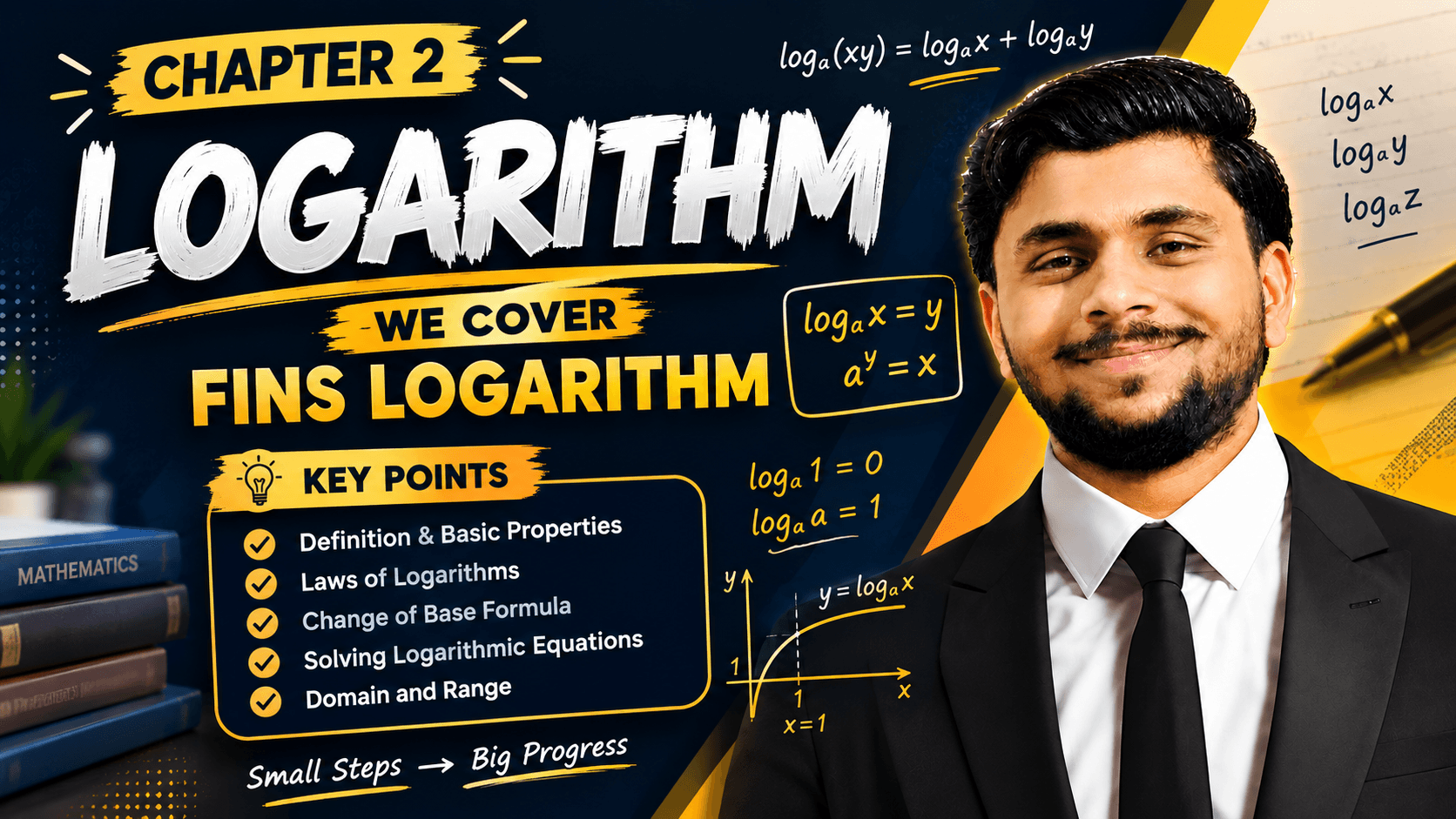
Logarithms. A logarithm answers the question "what power gives this number?". For example, log₁₀ 1000 = 3, because 10³ = 1000. Learn these laws by heart and practise using them both ways:
- log (m × n) = log m + log n
- log (m ÷ n) = log m − log n
- log (mⁿ) = n × log m
- Change of base: log_b m = log m ÷ log b
Class 9 students also learn to find the characteristic and mantissa of a common logarithm and to work out an antilogarithm. Write every step: a slip in the characteristic changes the whole answer.
Probability. Probability = number of favourable outcomes ÷ total number of equally likely outcomes. It is always between 0 (impossible) and 1 (certain). With a fair die, the probability of rolling a 4 is 1/6, and the probability of an even number is 3/6, which is 1/2. Most mistakes come from counting the outcomes wrongly, so list them before you calculate.
On Hunarzai you can learn both topics live, in Urdu, with M. Junaid: Class 9 Mathematics: Logarithm and Class 9 Mathematics: Probability.
Maths in engineering entry tests
If you plan to study engineering or computing, maths carries real weight in the tests.
- ECAT (UET Lahore): English is 10 questions. The remaining 90 questions are split equally between the other subjects in your chosen combination, and most combinations include mathematics. Each correct answer earns 4 marks, the test lasts 100 minutes and there is no negative marking. UET's ECAT page also lists calculators among items not allowed in the exam, so practise without one.
- NUST NET-Engineering: mathematics is 50% of the test, physics 30% and English 20%, according to NUST's weightings page.
Note that MDCAT has no maths section. The PMDC notice for MDCAT 2026 lists biology, chemistry, physics, English and logical reasoning. If you are on the medical path, read our guide on what MDCAT is and see how physics fits in on the Physics topic page.
Study habits that work for maths
- Practise a little every day. Twenty focused minutes daily beats a three-hour session once a week.
- Redo wrong questions a few days later. Keep a mistakes notebook and retry each one without looking.
- Write every step. Skipped steps hide errors and lose method marks.
- Time yourself before tests. For ECAT, the official timing is 100 questions in 100 minutes, so speed matters.
- Track your scores. Our percentage calculator helps you see whether your mock results are improving.
Questions to ask before you choose a tutor
- Which board and syllabus do you teach, and which year?
- How do you check my working between classes?
- Will you set past-paper practice, and how often?
- Which language will you teach in?
- If I miss a live class, is there a recording?
- What happens if the course does not suit me? (On Hunarzai, you can read the refund rules before you pay.)
Safety for young learners
For children, parents should stay involved from the first class.
- Sit in on the first session, or stay within earshot.
- Keep classes in a shared room of the house, not behind a closed door.
- Use the course platform for messages rather than private chats with the tutor.
- Never share home address, school name or photos beyond what the course needs.
- Ask your child after each class what they learned. If the answer is vague, look closer.
A simple roadmap
- Find out your board, class and exam date.
- List your weak topics honestly.
- Pick a course type: recorded for flexibility, live for structure, hybrid for both.
- Check the level and prerequisites stated on the course.
- Study daily, keep a mistakes notebook and do timed papers in the final weeks.
Questions people ask
Is an online math tutor as good as a home tutor?
It can be, if the tutor checks your working and sets regular practice. Online classes also let you replay recorded lessons, which helps with long methods. The key is your own daily practice, whichever format you choose.
How much does an online maths course cost on Hunarzai?
Teachers set the price up to Hunarzai's caps: up to PKR 4,999 for a recorded course, up to PKR 9,999 for a live course and up to PKR 7,999 for a hybrid course. Payment today is by bank transfer from any Pakistani bank or banking app.
Is maths part of MDCAT?
No. The PMDC notice for MDCAT 2026 lists biology, chemistry, physics, English and logical reasoning, with no maths section. Maths does carry heavy weight in engineering tests such as ECAT and NUST NET.
How important is maths in NUST NET?
For NET-Engineering, NUST gives mathematics a 50% weighting, physics 30% and English 20%. NUST says the test is compiled from textbooks prescribed for HSSC courses.
Can I use a calculator in ECAT?
UET's ECAT page lists calculators among the items not allowed in the exam. Practise mental arithmetic and quick working by hand while you prepare.
Can I study maths on my phone?
Yes. Hunarzai works fully on a phone and your progress syncs between phone and laptop. For maths, keep a notebook next to you and solve along with every lesson.
Sources (checked 13 October 2026)
- National Curriculum Council, Government of Pakistan
- About ECAT, UET Lahore
- ECAT home page and exam day rules, UET Lahore
- Subjects included in NET with weightings, NUST
- NUST undergraduate admissions
- PMDC public notice, MDCAT 2026 registration
- Cambridge O Level Mathematics (Syllabus D) 4024
- Cambridge International AS & A Level Mathematics 9709