

AI course guide: using ChatGPT, Gemini, Copilot and Claude for study and work
By the Hunarzai team. Facts checked 13 October 2026.
The short answer
A practical AI course teaches you to use tools such as ChatGPT, Gemini, Copilot and Claude for study, office tasks and small business work: writing clear prompts, checking answers, and keeping private data safe. It suits students, office staff and shop or business owners, and needs no coding. On Hunarzai a recorded course is capped at PKR 4,999, a hybrid course at PKR 7,999 and a live course at PKR 9,999, and you can start today by opening a free account on one of these tools and practising on a real task.What "AI course" usually means
The phrase covers two very different things. Most people searching for an AI course want to use AI tools well: get a first draft of an email, summarise a long PDF, plan a lesson or reply to customers faster. A smaller group wants to build AI systems, which is AI engineering and needs programming. This guide is about the first kind. If you want the second, see the section on AI engineering below.
A good practical course is not about learning one app. Tools change their names, models and limits often. What lasts is the method: give clear instructions, check what comes back, and protect your data.
Which AI tools have a free tier (checked 13 October 2026)
All four of these general assistants offer a free way in. Limits change, so check each official page before you rely on a feature.
| Tool | Free option | What the official page says about free use |
|---|---|---|
| ChatGPT (OpenAI) | Free plan | Text chats plus limited file uploads, image creation, voice and deep research. Paid plans are Go, Plus, Pro, Business and Enterprise. |
| Gemini (Google) | Free with a Google Account | Usage limits apply. Includes image generation and editing, Deep Research, Gemini Live, Canvas and Gems. |
| Microsoft Copilot | Free baseline experience | Answers, web research with sources, writing and translation help, and image creation. Copilot inside Word, Excel, PowerPoint and Outlook is linked to the paid Microsoft 365 Premium plan. |
| Claude (Anthropic) | Free plan | Chat on web, desktop and mobile, web search, file creation, Artifacts, and up to 5 projects. |
We have not listed prices. They are set in US dollars, change often, and may differ for Pakistani cards. Check the official page on the day you pay.
What a practical AI course should cover
- How these tools work, in plain words. They predict likely text from patterns. They do not "know" things the way a teacher does, which is why they can be wrong.
- Prompt basics. Writing a request that gets a useful answer first time.
- Checking output. Spotting made-up facts, fake references and wrong numbers.
- Privacy and safety. What not to paste in, and which settings to change.
- Real tasks. Study notes, emails, CVs, reports, social media captions, customer replies, simple spreadsheets.
- Working in Urdu and English. Asking for an answer in Urdu, translating a notice, or turning Roman Urdu notes into a clean English email.
- Knowing when not to use AI. Exams, signed documents, legal or medical decisions, and anything you cannot check.
Prompt basics you can use today
OpenAI's own guidance for ChatGPT comes down to three habits: be precise and give enough context, set the tone you want, and iterate by adjusting your prompt after reading the first answer. In practice, a strong prompt usually has four parts:
- Role and audience: "You are helping a shop owner in Multan write to customers."
- Task: "Write a WhatsApp message announcing new winter stock."
- Details: prices, dates, names and facts you supply yourself.
- Format: "Under 60 words, friendly tone, one line in Urdu at the end."
Then read the answer and ask for changes: shorter, simpler, more formal, a table instead of a paragraph. Matlab: pehla jawab aakhri jawab nahi hota, usay behtar karwayein.
Limits: always check AI output
OpenAI's help centre states plainly that ChatGPT is not always correct. It calls invented answers "hallucinations", warns they can include wrong facts and fabricated citations, and notes the model can sound confident even when wrong. It advises treating output as a starting point and verifying quotes, data and references.
A simple checking routine:
- Check every number, date, price and name against an official source.
- Open every link or reference. If you cannot find it, do not use it.
- For anything about Pakistani law, tax, fees or exam rules, go to the government body or board directly.
- Read the full answer before you copy it. AI text can be generic, and teachers and clients often notice.
- Do not submit AI writing as your own where your school, university or employer forbids it.
Data privacy: what not to paste in
Google's Gemini privacy notice says human reviewers, including reviewers from Google's service providers, may read some conversations, and asks users not to enter confidential information they would not want a reviewer to see. That is good advice for every AI tool.
- Do not paste CNIC numbers, bank details, passwords or OTP codes.
- Do not paste customer lists, patient details, salary sheets or private company files unless your employer has approved the tool.
- Remove names and personal details before asking for help with a document.
- In ChatGPT, you can turn off Improve the model for everyone under Settings, then Data controls, so new chats are not used to train models. Temporary chats are not used for training and may be kept for up to 30 days for safety reasons.
- Each tool has its own settings. Read the privacy page of the tool you use.
Using AI tools vs AI engineering
| Using AI tools | AI engineering |
|---|---|
| No coding needed | Programming needed, usually Python |
| You type requests into an app | You build apps that call AI models |
| Goal: faster study and office work | Goal: products, chatbots and automated systems |
| Weeks of practice | Months of study, maths and coding |
If you want to move from using AI to building with it, start with Python. To connect apps and remove repeated manual steps, see automation. To build a chatbot for a website or WhatsApp-style support, see AI chatbots. An "AI engineering course" or "generative AI course" aimed at developers will expect this background.
A simple roadmap
- Week 1: open free accounts on two tools. Use them for one real task each day, such as summarising notes or drafting an email.
- Week 2: practise the four-part prompt. Keep a file of prompts that worked.
- Week 3: practise checking. Ask a question you already know the answer to, and see where the tool goes wrong.
- Week 4: apply it to your own work: a CV, a business reply template, a study plan or a monthly report.
- After that: if you want to build, move to Python and automation. If you want to stay a user, go deeper into tools for your field.
Choosing a course
Look for a course that states its level and prerequisites, shows real tasks rather than only theory, teaches checking and privacy, and is honest that tools change. Be careful with any course that promises income or says AI will do all your work. On Hunarzai every course states its level and prerequisites and is checked by the Hunarzai team before it goes live.
The live AI course for students on Hunarzai
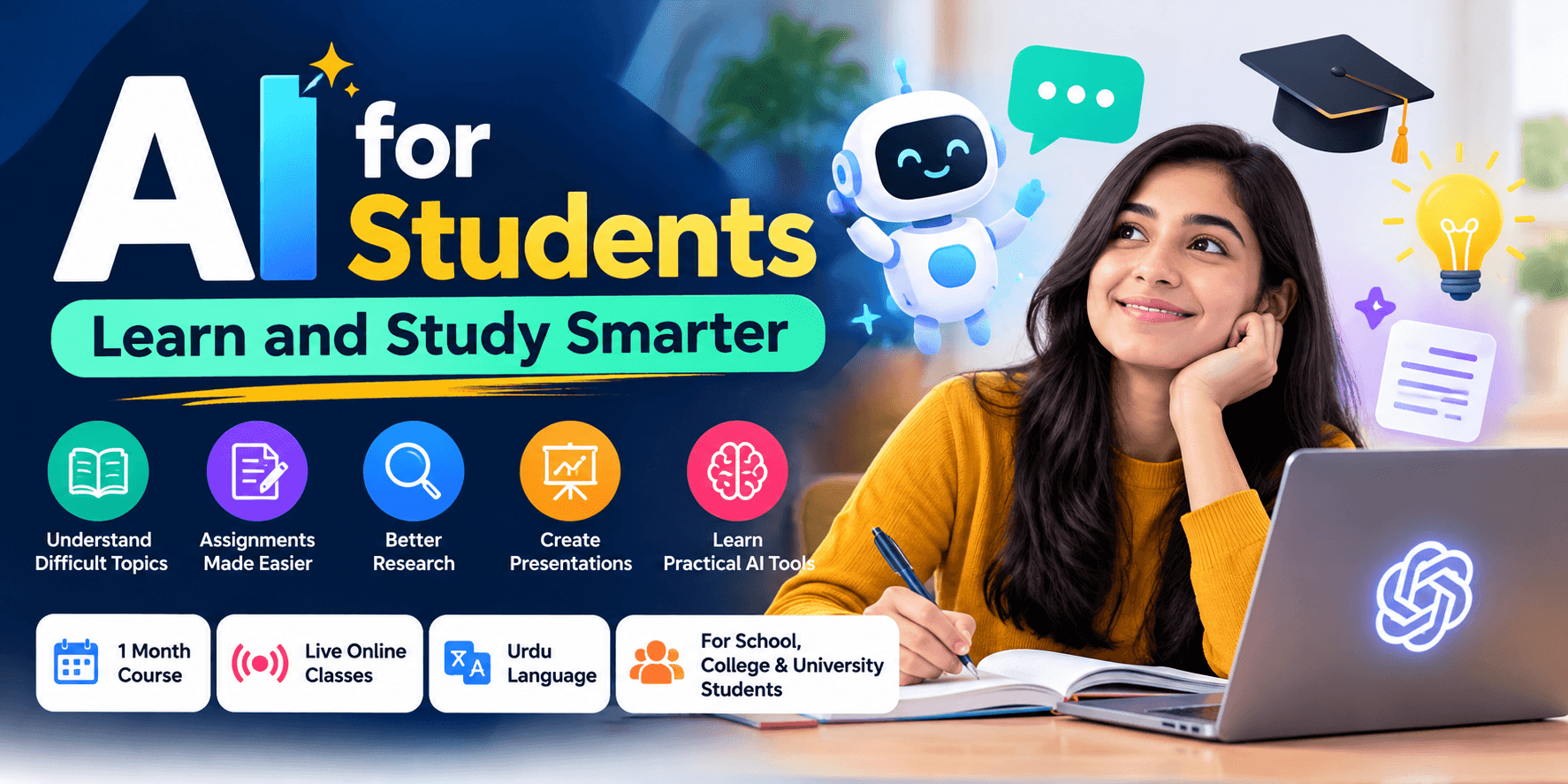
AI for Students: Learn and Study Smarter is a live course in Urdu by Hussain Ahmad. The teacher describes it as a one-month beginner course on using AI tools such as ChatGPT for studying, research, assignments and presentations, with no earlier AI experience needed. Live courses on Hunarzai cost up to PKR 9,999; check the course page for its price, class times and whether it is open to new students.
Questions people ask
Which AI course should a beginner choose?
There is no single right course for everyone. For most beginners the right course is a practical one that needs no coding and teaches prompts, checking answers and privacy using tools you can open for free. Choose one that states its level and uses tasks close to your own study or work.
Can I learn AI tools for free?
Yes, you can start for free. ChatGPT, Gemini, Microsoft Copilot and Claude all offer a free option, each with limits that change over time. A course helps by giving structure and practice, but the tools themselves can be tried at no cost.
Can I learn AI in one year?
You can become a confident user of AI tools in a few weeks of regular practice. Building AI systems is different: it needs programming, usually Python, and steady study over many months. Decide which goal you have before you choose a course.
How can I start learning AI after 12th (intermediate)?
Start by using AI tools for your own studies and writing, with careful checking. If you enjoy it and want to build things, learn Python next, then automation and chatbots. University degrees in computer science or AI are another route, so check admission rules with the university itself.
Is a prompt engineering course worth it?
Prompt skills help, but they are easier to learn as part of a wider course that also covers checking output and data privacy. Prompting is quick to learn and improves mainly through practice on real tasks.
Is it safe to put my documents into ChatGPT or Gemini?
Only if they contain nothing private. Google says human reviewers may read some Gemini conversations and asks users not to enter confidential information. Remove personal details first, and change the data settings in each tool.
Sources (checked 13 October 2026)
- ChatGPT pricing (Free, Go, Plus, Pro, Business, Enterprise)
- Claude pricing (Free plan features)
- Google Gemini subscriptions (free tier with Google Account)
- Microsoft Copilot for individuals (free baseline, Microsoft 365 Premium)
- OpenAI Help: Data Controls FAQ
- OpenAI Help: Does ChatGPT tell the truth?
- OpenAI Help: Prompt engineering best practices for ChatGPT
- Gemini Apps Privacy Hub